About This Book
Financial markets play a central role in modern economies by facilitating the mobilization of
savings, allocation of capital, investment, and wealth creation. As financial markets continue
to expand and become increasingly sophisticated, the need for an effective legal and
regulatory framework has become more important. Securities law provides the legal
foundation for regulating securities, protecting investors, promoting transparency, and
maintaining the integrity and orderly functioning of financial markets.
Securities Law and Financial Markets is designed to provide a comprehensive
understanding of the legal principles, regulatory mechanisms, financial instruments, market
institutions, and contemporary developments associated with securities markets. The book
connects fundamental concepts of securities law with the practical functioning of primary and
secondary financial markets.
The book begins with an introduction to securities law and financial markets, explaining
the nature and importance of securities regulation, the evolution of financial markets, major
market participants, and the role of financial markets in economic development. It provides
readers with a foundation for understanding the relationship between law, regulation,
investors, and market institutions.
The book then examines the regulatory framework of securities markets, including the
role of regulatory authorities, stock exchanges, market institutions, investor protection
mechanisms, and regulatory compliance. Particular attention is given to the importance of
transparency, accountability, and orderly market practices.
A major focus of the book is the study of securities and financial instruments. Equity
shares, preference shares, bonds, debentures, derivatives, mutual funds, and other financial
instruments are examined to help readers understand their characteristics, functions, and
relevance within financial markets.
The primary market is another important area covered in the book. Public issues, initial
public offerings, follow-on public offers, rights issues, private placements, preferential
allotments, disclosure requirements, and listing requirements are discussed to explain how
securities are issued and introduced into the market.
The book also explores the secondary market and stock exchange operations. Trading
mechanisms, clearing and settlement systems, listing and delisting, and the role of market
intermediaries are examined to provide an understanding of how securities are traded after
their initial issuance.
Financial markets depend on a wide range of professional institutions. The book therefore
discusses brokers, merchant bankers, underwriters, depositories, credit rating agencies,
investment advisers, and other intermediaries, together with their responsibilities and
regulatory obligations.
Investor confidence is essential for the effective functioning of securities markets. The book
examines investor protection, disclosure, transparency, insider trading, market
manipulation, unfair trade practices, and grievance redressal mechanisms. These areas
demonstrate the importance of maintaining fairness and integrity within financial markets.
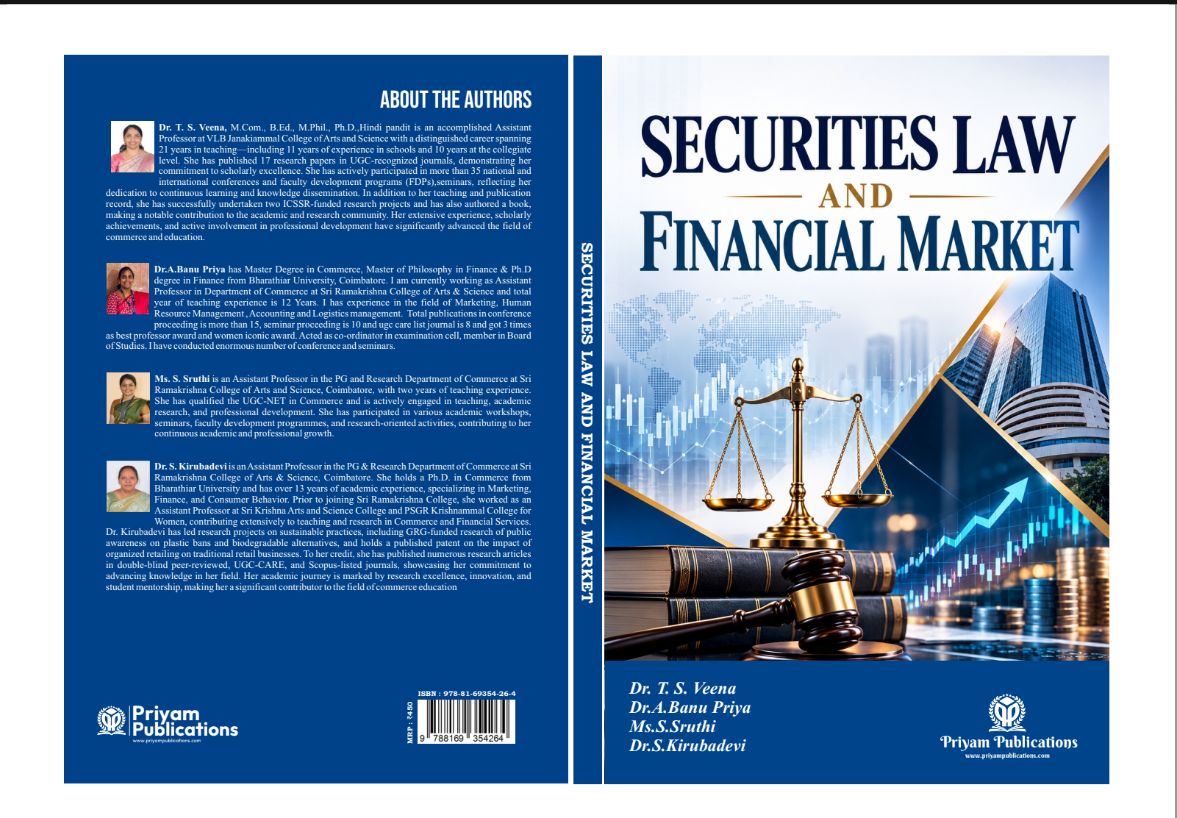
Author Details:
Dr. T. S. Veena,
Assistant Professor
VLB Janakiammal College of Arts and Science, Coimbatore
Dr.A.Banu Priya
Assistant Professor
Department of Commerce
Sri Ramakrishna College of Arts & Science, Coimbatore
Ms.S.Sruthi
Assistant Professor
PG & Research Department of Commerce
Sri Ramakrishna college of arts & science, Coimbatore
Dr.S.Kirubadevi
Assistant Professor
PG & Research Department of Commerce
Sri Ramakrishna college of arts & science, Coimbatore