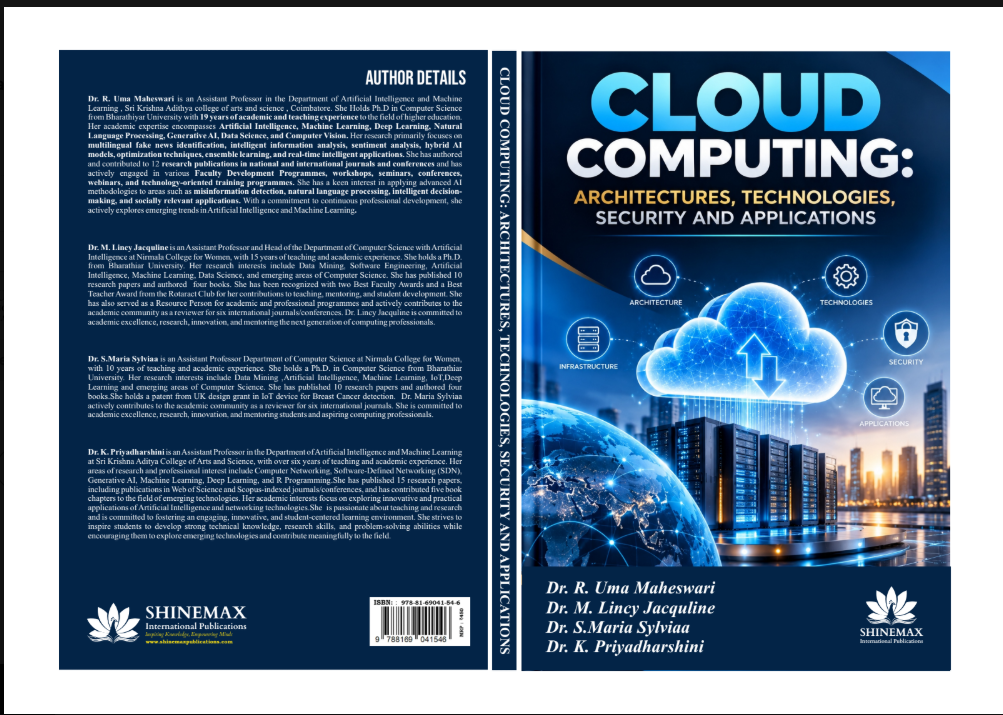
CLOUD COMPUTING: ARCHITECTURES, TECHNOLOGIES, SECURITY AND APPLICATIONS
About This Book
Cloud computing has become one of the most significant technological developments in modern information technology. The increasing demand for scalable infrastructure, flexible computing resources, distributed applications, data storage, and on-demand digital services
has accelerated the adoption of cloud technologies across organizations and industries. From business applications and e-commerce to healthcare, education, finance, artificial intelligence, and government services, cloud computing provides an important technological foundation for digital transformation. Cloud Computing Architectures, Technologies, Security and Applications has been designed to provide a comprehensive understanding of the fundamental concepts, architectural principles, enabling technologies, security mechanisms, and practical
applications of cloud computing. The book presents cloud computing from both theoretical
and practical perspectives and provides a structured foundation for students, researchers,
educators, IT professionals, developers, and technology enthusiasts.
The book begins with the foundations of cloud computing, introducing its meaning,
evolution, characteristics, benefits, service models, deployment models, and fundamental
architectural components. Understanding these concepts is essential for examining how cloud
environments deliver computing resources and services to users.
The book then explores cloud computing architectures, focusing on architectural principles,
front-end and back-end components, distributed computing, virtualization, multi-tenant
environments, scalability, and fault tolerance. These concepts help readers understand how
cloud systems are designed to support reliable and flexible computing environments.
A significant part of cloud computing infrastructure is virtualization. The book examines
server, storage, and network virtualization, hypervisors, virtual machines, containers, and
container-based infrastructure. These technologies form an important foundation for efficient
resource utilization and modern cloud-native environments.
The book also addresses cloud storage and data management, covering object storage,
block storage, file storage, distributed storage systems, cloud databases, data backup,
recovery, and disaster management. These topics highlight the importance of reliable and
scalable data management in cloud environments.
Cloud networking and resource management are examined through discussions of virtual
networks, software-defined networking, virtual private networks, load balancing, traffic
management, resource allocation, and optimization. These concepts provide an understanding
of how cloud infrastructure can efficiently manage network connectivity and computing
resources.
The book further discusses major cloud technologies and service platforms, including
Infrastructure as a Service, Platform as a Service, Software as a Service, serverless
computing, Function as a Service, containers, Kubernetes, and cloud-native technologies.
These service models and technologies have significantly influenced modern application
development and deployment.
Author Details :
Dr. R. Uma Maheswari
Assistant Professor
Department of Artificial Intelligence and Machine Learning,
Sri Krishna Adithya College of arts and science, Coimbatore.
Dr. M. Lincy Jacquline
Assistant Professor and Head
Department of Computer Science with Artificial Intelligence
Nirmala College for Women, Coimbatore
Dr. S.Maria Sylviaa
Assistant Professor
Department of Computer Science
Nirmala College for Women, Coimbatore
Dr. K. Priyadharshini
Assistant Professor
Department of Artificial Intelligence and Machine Learning
Sri Krishna Aditya College of Arts and Science, Coimbatore