About This Book
Deep Learning has emerged as one of the most transformative areas of Artificial Intelligence, enabling machines to learn complex patterns, extract meaningful representations, and make intelligent decisions from large and diverse datasets. From computer vision and natural language processing to healthcare, finance, robotics, autonomous systems, cybersecurity, and intelligent business applications, deep learning architectures are increasingly becoming an essential foundation for modern technological innovation. The rapid development of neural network models has created new opportunities for researchers, students, educators, and professionals to explore intelligent solutions to real-world problems.
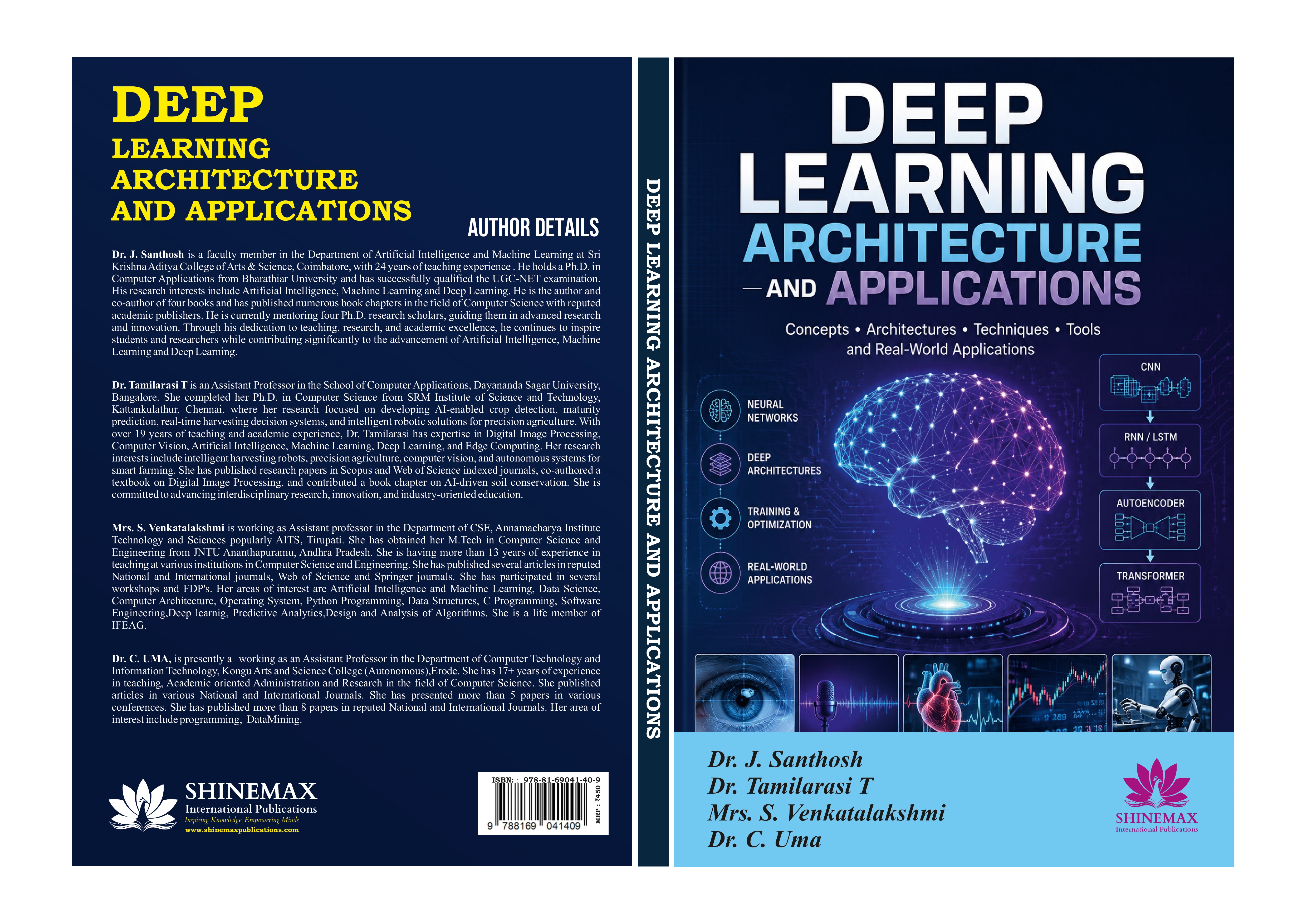
Deep Learning Architecture and Applications is designed to provide a comprehensive understanding of the fundamental concepts, architectures, methodologies, and practical applications of deep learning. The book introduces readers to the evolution of artificial neural networks and gradually progresses toward advanced deep learning architectures. It focuses on both theoretical foundations and application-oriented perspectives, enabling readers to understand not only how deep learning models work but also why particular architectures are appropriate for specific problems.
The book covers important architectures and concepts including Artificial Neural Networks, Deep Neural Networks, Convolutional Neural Networks, Recurrent Neural Networks, Long Short-Term Memory networks, Gated Recurrent Units, Autoencoders, Generative Adversarial Networks, Transformer architectures, and other emerging deep learning models. Key aspects such as activation functions, optimization algorithms, loss functions, backpropagation, regularization, hyperparameter tuning, transfer learning, feature representation, model evaluation, and computational considerations are also discussed.
A major emphasis of this book is placed on the practical applications of deep learning. Readers are introduced to its use in image and video analysis, speech and language processing, healthcare and medical diagnosis, financial prediction, recommendation systems, smart cities, agriculture, education, industrial automation, cybersecurity, natural language understanding, and autonomous systems. These applications demonstrate how deep learning can transform raw data into valuable insights and support intelligent decision-making.
The book is intended to serve as a useful academic resource for undergraduate and postgraduate students of Computer Science, Information Technology, Artificial Intelligence, Data Science, Engineering, and related disciplines. It can also benefit researchers, educators, developers, and professionals seeking to strengthen their knowledge of deep learning architectures and their real-world applications. The systematic presentation of concepts makes the book suitable for classroom teaching, self-learning, research reference, and project development.
As deep learning continues to evolve, new architectures, frameworks, datasets, and applications are constantly emerging. Therefore, this book also encourages readers to develop a research-oriented perspective and explore emerging areas such as explainable AI, multimodal learning, generative AI, foundation models, edge intelligence, federated learning, and responsible AI. Understanding the strengths, limitations, ethical considerations, and computational requirements of deep learning systems is increasingly important for developing reliable and responsible intelligent technologies.
We sincerely hope that Deep Learning Architecture and Applications will provide readers with a strong conceptual foundation, practical understanding, and inspiration to explore the rapidly expanding field of deep learning. It is our belief that the knowledge presented in this book will contribute meaningfully to academic learning, research innovation, and the development of intelligent solutions for the challenges of tomorrow.
AUTHOR :
Dr. J. Santhosh
Dr. Tamilarasi T
Mrs. S. Venkatalakshmi
Dr. C. Uma